image description

Posts Tagged ‘Sleep’

Currently viewing page 3 of 7123456Last

THREE WAYS IN WHICH SLEEP DEPRIVATION IS LIKE DRINKING

Monday, April 25th, 2011

A recent piece in the NYT highlighted research from the sleep labs at Penn and Washington State University that has documented the effects of sleep deprivation on cognitive functioning such as attention and decision making. This is a really interesting area of research and it made me think about the similarities between impairments due to sleep deprivation and impairments due to drinking alcohol or being drunk.

1. Sleep deprivation and alcohol consumption affect your performance and decision making in a dose-dependent manner. There is plenty of research showing that acute sleep deprivation and acute alcohol consumption can affect attention, memory, reaction time, decision making, etc. This is one way in which sleep can interact with our decisions regarding choices related to food and movement. However, what might be less appreciated is the cumulative effects of sleep deprivation, which also parallel the cumulative effects of heavy drinking. That is to say that research has shown that even small amounts of sleep deprivation can add up over time. Researchers call this “sleep debt” and some believe that it must be paid off in the form of catching up on sleep over successive nights - perhaps one of the truly refreshing aspects of taking a vacation.

2. Sleep deprivation and alcohol consumption affect different people differently. In the same way that different people can have a low or high tolerance for the effects of alcohol, some people have a low or high tolerance to the effects of sleep deprivation. Some people require more sleep than others, are more disrupted by sleep deprivation, and require more time to make up for lost sleep. This is why it is good to follow general guidelines regarding how much sleep you should get, but it is even better to be closely in tune with your body and to give yourself additional hours of sleep if you feel that you need it.

3. Sleep deprivation and alcohol consumption cause impairment without you fully knowing that you are impaired. This is perhaps one of the more sinister effects of alcohol that can lead to incidents of drunk driving. Alcohol causes impairments in attention and reaction time, but the person who is impaired feels as though they are not. Their awareness of their impairment has also been affected. Sleep deprivation produces similar effects. Indeed, studies such as the one profiled above have shown that people might report that they feel a bit sleepy, but that their sleepiness was not affecting their performance (sound at all like, “I’m ok to drive”) when in fact the sleep deprivation they had experienced significantly decreased their cognitive performance.

So, what do we take away from this? Sleep deprivation is a tricky thing. A little bit can add up over time, one or two nights can wipe you out for a while, and the effects can sneak up on you without you fully realizing it. We think it’s worth taking care to try to ensure that you get a good night’s sleep every night.
THE NYT ON FOOD, MOVEMENT, AND SLEEP

Friday, March 25th, 2011

Today we review three recent stories from the NYT times on food, movement, and sleep - read them online for free while you still can…

1) Food. Mark Bittman writes about six things that we can feel good about with regard to the changing landscape of food. They include: greater political organization and power around food issues; changing practices among large food retailers (Wal-mart and McDonalds); the growth of farmers markets, food co-ops, and CSAs; an increase in community gardens and urban agriculture; the increased number of small farms (particularly farms being started by younger folks); and the efforts to improve the quality of school lunches.

2) Movement. Gretchen Reynolds describes a paper published in the journal Proceedings of the National Academy of Sciences in which exercise (running) appears to have extended the lives and improved the health of mice that carry a (mitochondrial) mutation that results in accelerated aging. In this study, mice who were genetically prediposed to age faster than normal mice and who were forced to run for 45 min three times a week lived longer and exhibited better signs of health as compared to similar mice who were not forced to run. This study suggests several biological mechanisms by which exercise might help slow the aging process.

3) Sleep. Paula Span describes a paper published in the Archives of Internal Medicine in which providing a group of 79 senior citizens who had insomnia with four simple rules for sleep significantly improved their sleep patterns. So, what were the four rules? 1) reduce the time spent in bed (to your sleep time + 30 min, but not less than six hours); 2) get up at the same time every day; 3) do not go to bed unless you are sleepy; and 4) do not stay in bed if you cannot fall asleep.

Have a great weekend folks.

THAT DUDE IS AN AWESOME SLEEPER!

Friday, January 28th, 2011

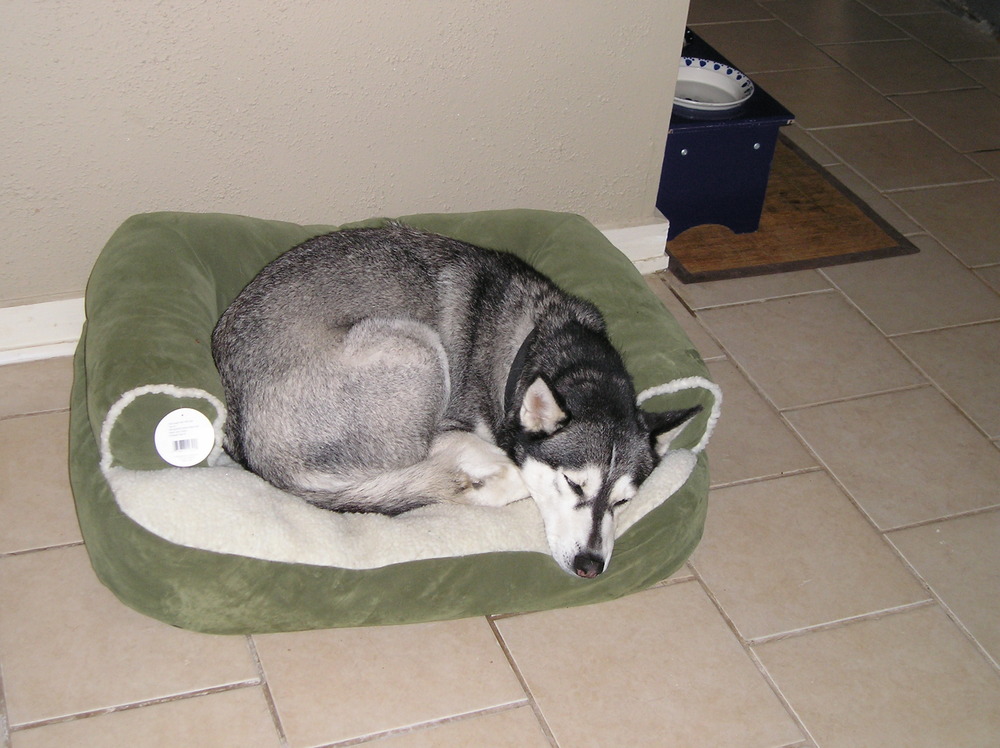
P1011937

(Guinness, my Siberian Husky who sure knows how to sleep)

Have you ever said the title of this post out loud or have you even thought it to yourself? Of course you haven’t. Sleep is underrated. It is easy to fail to connect the dots between the amount and quality of our sleep and the effects that it has on our productivity, choices, appetite, exercise, weight, and overall happiness. Unfortunately, we also tend not to think that one can become significantly better at sleeping. This is simply not true.

In the 2008 book “Talent is overrated: what really separates world class performers from everybody else” the authors describe some of the key components to self-improvement. For example:

“The best performers observe themselves closely. They are in effect able to step outside themselves, monitor what is happening in their own minds, and ask how it’s going…Top performers do this much more systematically than others do; it’s an established part of their routine.”

“Excellent performers judge themselves differently from the way other people do. They’re more specific, just as they are when they set goals and strategies. Average performers are content to tell themselves that they did great or poorly or okay. The best performers judge themselves against a standard that’s relevant for what they’re trying to achieve. Sometimes they compare their performance with their own personal best; sometimes they compare with the performance of competitors they’re facing or expect to face; sometimes they compare with the best known performance by anyone in the field.”

“If you were pushing yourself appropriately and have evaluated yourself rigorously, then you will have identified errors that you made. A critical part of self-evaluation is deciding what caused those errors. Average performers believe their errors were caused by factors outside their control: My opponent got lucky; the task was too hard; I just don’t have the natural ability for this. Top performers, by contrast, believe they are responsible for their errors. Note that this is not just a difference of personality or attitude. Recall that the best performers have set highly specific, technique-based goals and strategies for themselves; they have though through exactly how they intent to achieve what they want. So when something doesn’t work, they can relate the failure to specific elements of their performance that may have misfired.”

In my experience, I have found these statements to be absolutely true. For example, it is quite common if not ubiquitous among serious athletes to record videos of their performance for subsequent review. This is important because 1) the tape doesn’t lie and 2) it is easier to see what is going wrong when you are not engaged in the activity. Both of these things point to objective assessment and improvement. I experienced this first-hand in a college course in which the professor taped our presentations and reviewed them with us. It was a really useful exercise to be able to see yourself say “um” about 200 times or to realize how much your had been fidgeting and how distracting it could be.

So, back to sleep. Have you ever tried to analyze or track how you have been sleeping? If sleep is important to you, consider how you might try to become the Michael Jordan, Tiger Woods, or Michael Phelps of sleeping. You might seek out information, training, or coaching on sleeping well. You might purchase some high quality sleep equipment (i.e., comfortable bedding, heavy drapes). You might keep track of how you are sleeping, what and where things are going wrong, and try to trouble-shoot those areas. I find that when I think of sleep as a sport or an activity at which I can improve, I approach sleep in a completely different way that gives it the importance that it truly deserves.

Sleep well,

Larry

Currently viewing page 3 of 7123456Last