
ARE YOU AN EARLY BIRD OR A NIGHT OWL?
Thursday, June 2nd, 2011In the classic 1984 movie Gremlins, there are three basic rules that are are explained for keeping a Mogwai (pictured above) as a pet.
1. Don’t get him wet
2. Keep him away from bright lights
3. Don’t feed him after midnight
As you know from the movie, feeding after midnight can have disastrous consequences. In a new study out of Northwestern University, it looks like staying up late and eating after 8:00 PM can also go a long way to derail your effort to achieve and sustain your ideal weight.
Sleep duration, or the number of hours you sleep each night, has been linked to obesity. That is to say that people who get less sleep on average, are more likely to be overweight or obese. However, less is known about how the timing of your sleep might affect your weight. Different people keep different schedules due to work or other responsibilities and some people just feel that they are naturally a “morning person” or a “night person.” The goal of the study that we’re talking about today was to see how sleep schedules affect dietary patterns and BMI.
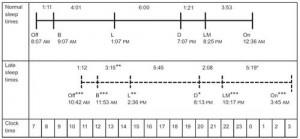
(Figure 1 from Baron et al., 2011)
The study looked at the sleep and eating habits of 52 people (25 females) over a week. They characterized half of the people as “normal sleepers” who tended to go to sleep around 12:30 AM and wake up around 8:00 AM (see the figure above for average sleep, wake, and meal times). The other half of the participants were characterized as late sleepers who tended to go to sleep around 3:45 AM and wake up around 10:45 AM (note the total hours of sleep time are pretty similar). Take a look at the figure and see which group would you most likely fall into.
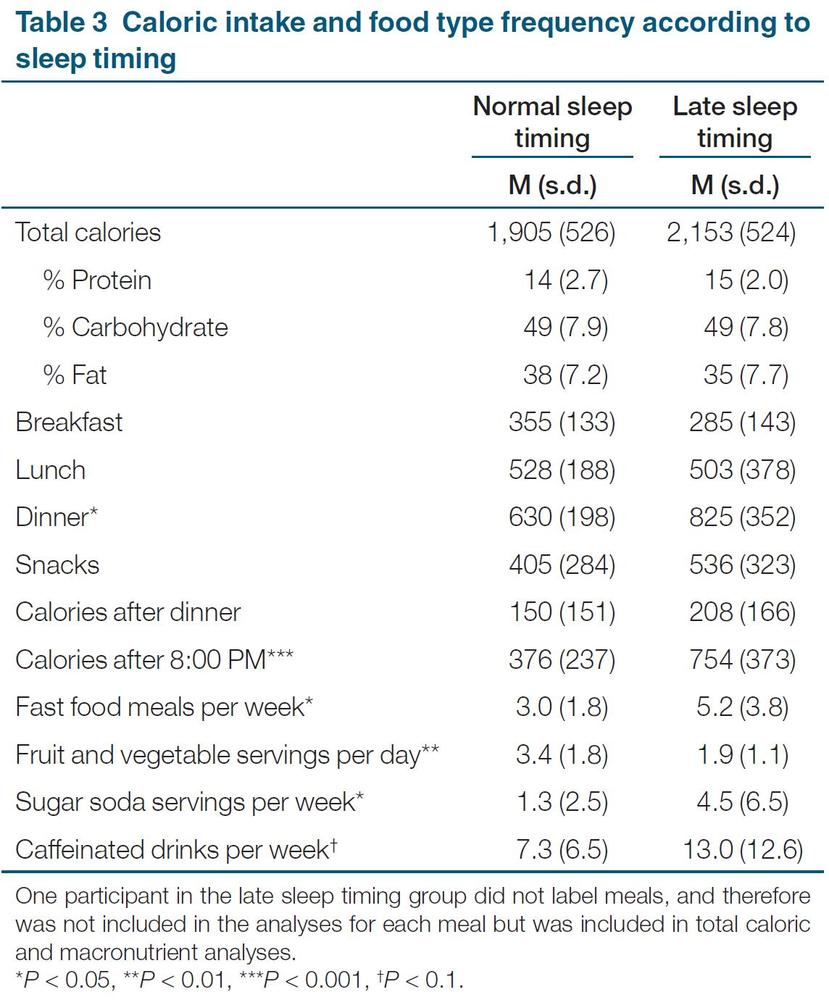
(Table 3 from Baron et al., 2011)
The authors found that compared to “normal sleepers,” “late sleepers” consumed significantly more calories at dinner, ate more fast food, drank more pop (soda for you folks not from the Midwest), and ate fewer servings of fruits and vegetables (see table above). When subjected to fancy statistical models, the data showed that higher numbers of calories consumed after 8:00 PM were predictive of higher BMI’s, even after controlling for sleep timing and sleep duration. Thus, it appears as though there is an independent risk for weight gain associated with eating after 8:00 PM. But, why did this affect the types of things consumed? Perhaps fast food is more available and fruits and vegetables less available in the evenings? Or was there a potential interaction between sleep and decision making? In any case, there are interesting future questions to be asked, but in the interim, the authors suggest that regulating the timing of your eating and sleeping could improve the effectiveness of your efforts to achieve or sustain your ideal weight.