image description

Posts Tagged ‘Self-Tracking’

How light exposure affects health - an interview of Dan by Dr. Joseph Mercola

Sunday, January 19th, 2014


Today, my video interview with Dr. Mercola was published. We talked about how to get great sleep and the influence of light on health, sleep, and daytime alertness.

Here are some of the summary notes posted on his website.

  • If you don’t sleep well, you’re not going to be optimally healthy no matter how good your diet and exercise are.
  • Maintaining a natural rhythm of exposure to daylight, and darkness at night, is an essential component of sleeping well.
  • Light is important because it serves as the major synchronizer of something called your master clock. Other biological clocks throughout your body in turn synchronize to your master clock
  • To maintain and “anchor” your master clock, you want to get bright outdoor light exposure for 30-60 minutes a day
  • In the evening, avoid the blue light wavelength. This can be done by using blue-blocking light bulbs, dimming your lights, and if using a computer, installing a blue light-blocking software (F.Lux)


Getting the right light exposure across the day, evening, and night is crucial to helping you get regular, deep sleep and to support robust wakefulness during the day. It takes time to experience the maximal benefit of proper light exposure. You need to have the right light at the right time for multiple days in a row to experience the full effect on improved daytime alertness. However, as discussed in the beginning of the interview, duration and timing of sleep also impact the equation. In our modern world – due to a large amount of forces of modern life - it’s easy to get less sleep than you need and to have too much variability in timing of your sleep.

At the end of the interview, we discussed self tracking for sleep practice mindfulness. To solve the problem of variable sleep timing and insufficient sleep duration, Dan’s Plan created a free sleep tracking tool (video description) that uses effective behavioral techniques to keep you mindful of how you’re living day by day. It’s not hard to imaging how making this tool a part of a person’s daily routine could lead to the addition of 30 extra minutes of sleep per night. If you’re like most people, and you’re getting insufficient sleep on a regular basis, these 30 minutes per night are a huge benefit. Practiced over time, the difference is equivalent to you missing 22 complete nights of sleep over 1 year!

Some new quantified self devices provide feedback on sleep stages. However, it’s normal for sleep to adjust night after night so this sort of detailed sleep analysis – unless your diagnosing a sleep issue – isn’t really necessary. At worst, it’s misleading. A better use of these new technologies should aim to help you maintain the behaviors that help you get good sleep, like getting into bed at the right time. If I were to tell you that your sleep efficiency score from last night was 85%, what does that mean to you? Is that good, bad, or normal? On the other hand, if the tool were to remind you that your target bedtime is, let’s say, 10:45p, but you’re going to bed on average at 11:30p recently, now you have increased mindfulness and a clear goal for what you can do tonight to get the sleep you need. That’s very useful, especially since there are many temptations that make missing sleep easy. This sort of tool helps you fight back, making the right sleep behavior more visible and salient in your day-to-day lifestyle. Tracking, therefore, is useful for both the novice and expert alike, because regardless of you level of knowledge of the sleep science, mindfulness of your own daily sleep practice helps you maintain a healthy pattern long term, and that’s what counts in the end.

Bottom line:

It’s challenging to get the sleep you need in the modern world. To get the sleep that helps keep you healthy and performing at your best, it’s useful to learn the fundamental components of good sleep (discussed in the video above), maintain smart light rhythms day by day, and engage with the right tools to keep you mindful of your daily sleep practice. Sleep is hugely important in our health and these are some of the cutting-edge but practical techniques to help you get the best sleep possible. If you’re not tracking sleep now, you should start today. Over the course of time, doing so will mean you’ll be more likely to get better sleep which will have enumerable benefits on your health and daily experience.
 

Hyper-Minimal WODS: Daily Workouts, Redux

Wednesday, August 1st, 2012

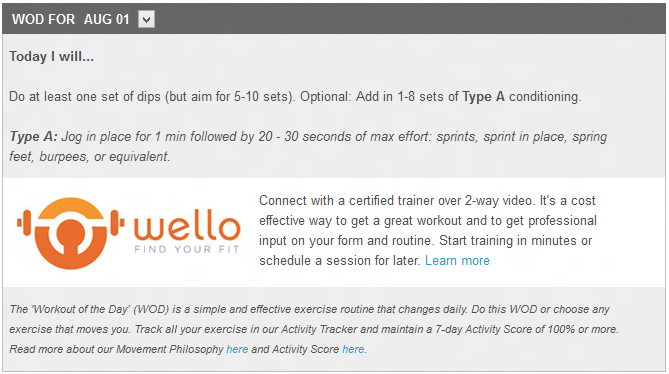
Exanple of a daily workout by Dan's Plan


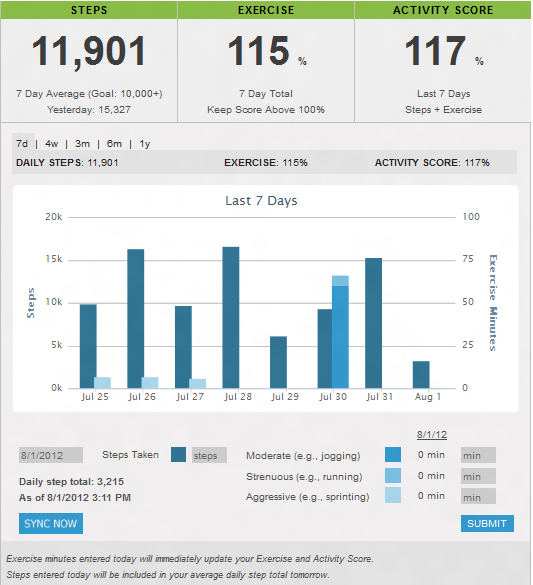
There are many good ways to exercise. If you’re training for skill performance, it’s smart to use a training program shown to deliver results. However, if your bias for physical activity revolves around doing what’s necessary to facilitate health, you should emphasis consistency vs intensity. Indeed, regular physical activity helps you be healthy; it helps you feel good, look good, sleep well, sex well, think well, and live long. Even if you care to ramp up activity for the occasional performance goal (i.e., “I’m going to get in shape for a mountain biking trip I have coming up“), you still should maintain a practice of sufficient, regular physical actively between periods of heavier training. That’s why we designed our Hyper-Minimal WOD (Workout of the Day). The goal is to make it as easy as possible to fit physical activity into your life. Each day, a new WOD is posted on your My Plan page (see example of a My Plan page below).

Here is the WOD for August 1st, 2012:

Today I will…

Do at least one set of dips (but aim for 5-10 sets). Optional: Add in 1-8 sets of Type A conditioning.

Type A: Jog in place for 1 min followed by 20 - 30 seconds of max effort: sprints, sprint in place, spring feet, burpees, or equivalent.

HOW THE WODS ARE DESIGNED

  1. Low bar for success. Doing at least one set in a day means your successful. More is great. Get moving!
  2. Bodyweight oriented. Equipment friendly.
  3. Simple design. Easy to remember. Uncomplicated.
  4. Each day has two parts: strength move + conditioning option (but feel welcome to just do the conditioning option if you like)
  5. The conditioning option: Two types (A & B), both simple. You don’t need fancy equipment to sprint in place for 20 seconds.
  6. Do all work in a cluster (workout) or spread the stimulus across the day (as I usually do). If you have two minutes, you have time to fit physical activity into your life. Additionally, it may be FAR easier for some to find 1-2 minutes multiple times a day than it is to find a free block of 20-30 minutes. Additionally, some research suggests that physical activity spread across the day is more beneficial than a workout followed by 15 hours of being sedentary. Besides, the longest lived societies on earth don’t “exercise” as we know it. Instead, their lifestyle involve regular activity - this is telling.
  7. Modify the exercise to make it appropriate for your level. Here is a video from FitStream on how to make body weight dips easier and harder. Modifications can be made for any movement listed in the daily WOD. I always start easy and then make the WODs harder by using additional weight or a weight vest as the day progresses. By the way, I do my dips on a corner in my kitchen (kinda like this). Be safe, creative, and opportunistic.
  8. No rep prescription. If you can do 15 reps of a certain exercise but you feel like doing only 12, do 12. Do what’s right for you in that moment and listen to your body. If you feel great, push it! If you’re not “feeling it” that day, just do what feels right. Some physical activity is energizing so you’re likely to feel good just moving a little. Be sure to tally the set in the correct category of our Activity Tracker (see blow).

TRACK TOTAL ACTIVITY VOLUME

The Dan’s Plan Activity Tracker is designed to make it super easy to enter steps and exercise, which provides a measure of total activity. The exercise tracker is based on a scale of perceived exertion, ranging from 1 to 10: 1 to 4 on the scale would be things like sitting, standing, and walking: not exercise; 5 being the minimal exertion level necessary to categorized as ‘exercise’; 10 being a maximal effort. Enter daily totals in the Activity Tracker across our three categorizes of self-rated effort:

1. Moderate: Anything you rate as a 5-7 (I went for a 20 minute jog today).

2. Strenuous: Anything you rate as a 7-8 (15 minutes out of my 60 minute yoga class were in the Strenuous category for effort).

3. Aggressive: I did 7 near-max effort push up sets with a weight vest today. Give yourself 1 min for each set.

The entry for this day would be:

Moderate = 20 min

Strenuous = 15 min

Aggressive = 7 min


Precision is not required. Estimate your times in each category to get a global idea of your activity volume. Here is a trick I use for tracking my WODs. Near max efforts gets one minute per set in our Aggressive category. Sub max efforts tally one, two, three minutes (whatever I actually did, like for example, 3 minutes of jump rope) in the Strenuous category. Keep your Activity Score above 100% at all times. Basically, 100% represents the physical activity volume recommendations by various national organizations (American Heart Association, US Department of Health and Human Services, and other biggies). By the way, the Activity Score looks at your last 7 days of activity and changes daily, so basically, you can ask yourself “over the last 7 days, have I maintained a sufficiently active lifestyle?” If you’re anything like me, you will find this totally addicting.

Tracking is super valuable. It can show time-series data helping you make associations, like how you feel based on your health habits / practice. Additionally, it helps you be mindful of how you’re living RIGHT NOW; I consider this to be the most important benefit of tracking. Our tracking takes less than 1 minute a day and helps you keep your daily health practice top of mind.

Tracking: get’r done!

WELLO

You’ll also notice the ad for Wello in the WOD image above. Wello is our *hawt* new partner that is disrupting (in start up parlance) the ginormous personal training industry. This cool company brings personal training into your living room via 2-way video chat. There are so many applications for their product, here are just a few I can think of:

  1. Utilizing a trainer to walk you through a training session while in the comfort of your own home (obvious). Also, you could be done with your workout by the time you got to your gym (this matters!).
  2. Find someone who has true expertise in a specific technique you’re training. Instead of choosing from the 3 trainers in your gym, search a much larger database and find the right person for you. By the way, personal training is not just for beginners. Formerly, I was the Assistant Head Strength and Condition Coach for a Div 1 university. I learn from trainers all the time. Open yourself to regular or period discussions with someone who has a fresh perspective on the science and art of ass-moving.
  3. Work with a trainer to develop a specific training program, then do the program mostly on your own, but check in via video chat periodically for feedback, tips, and to make modifications.
  4. Wanna help someone you love be more active? Gift a training session for your mom or dad. You can screen trainers and set up a training session for this person. Just be sure to practice using 2-way video with this person ahead of time so this doesn’t become an excuse.
  5. If you have some questions about how to perform one of our WODs, work with a Wello trainer, ask lots of questions, and feel uber confident you’re doing everything right.

I’d love to write more but I have to go do a set of dips. Do one with me!

Dan