image description

Just do it - thoughts on behavior change from The Reality-Based Community

One of my favorite blogs is The Reality-Based Community (Subtitle: Everyone is entitled to his own opinion, but not his own facts), which is authored by a group of smart and insightful professors of law, public policy, political science, and psychiatry. It makes for interesting reading and is a good way to keep up on the news without having to wade through much of the junk that the major media outlets cover.

Last week, Keith Humphreys (Professor of Psychiatry at Stanford) posted a nice piece on behavior change and “just doing it” (yes, there is even a story in there about that kind of “doing it” - read here). What I like about his post is that, although we have all kinds of theories about behavioral change that involve contemplation of change, developing motivation, etc., etc., sometimes behavior change comes about just by, well, changing your behavior. That is to say, by just doing it.

In the post, Humphreys writes, “So, if you have slacked off at the gym, the best thing may not be to speculate as to why, wait for the moment when you feel really ready or spend hours kicking yourself for not going. Rather, just go to the gym whether you feel like it or not, right now if possible. There is a good chance that the next time your gym day rolls around you will be more interested in going and much more likely to indeed follow through with the behavior.” (emphasis added)

With a slight modification (that is, to tailor your activity level to how you are feeling), I like the idea of just doing it. And, since we typically feel better after a workout or engaging in physical activity, Humphreys is right that gaining exposure to that reinforcer (the post-workout high) increases the likelihood that you will do it again.

So, the next time that you find yourself thinking about how you’d like to eat better, get in shape, or get more sleep, stop thinking and start doing. Go do it!
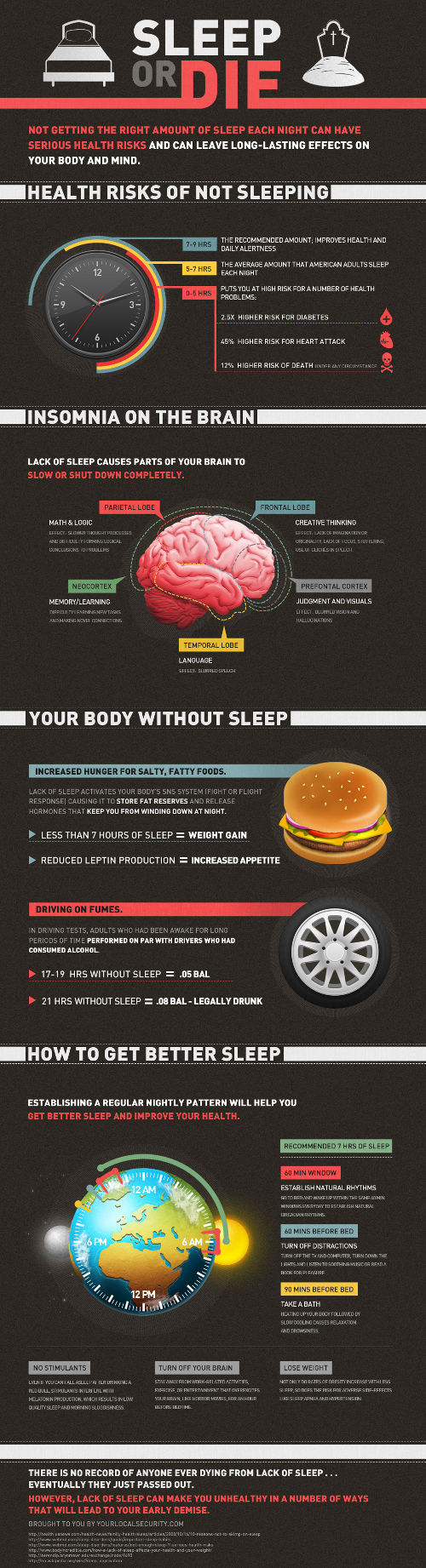

Sleep or die - infographic from the folks at In Good Measure and Your Local Security

Lack of Sleep Infographic
Via: YourLocalSecurity.com

Thought for the day - from the great Dr. Bill Dement

Dr. William Dement

Dr. Dement is considered to be one of, if not the, Father of Sleep Medicine. You can click here to read a bit about this man’s incredible career and accomplishments.

One of the things that Dr. Dement has been known to say, and that serves as our thought for the day, is that the sleep debt in the US is greater than the National debt.

Wow. That sounds like a bold statement these days when it seems like we cannot turn on the news without hearing of our growing Federal debt. So, is Dr. Dement right? Let’s try to crunch the numbers.

1) The US Treasury lists the Federal debt at approximately 15.4 trillion dollars.

2) The US Census Bureau lists the US population at approximately 313 million people.

3) 15.4 trillion divided by 313 million is about $49,000 per person. So, how does that compare to the costs associated with sleep loss?

Shift workers and people who work the night shift tend to have variable schedules and disrupted sleep. In a paper published in 2003 (click here for the full text), scientists summarized the results from seven different studies that assessed the relative risk of accidents and injuries in people who worked successive night shifts. What they found was that working successive night shifts dramatically increased the relative risk of accident and injury. Compared to night 1, risk of accident or injury was increased by 6% on the second night shift, by 17% on the third night shift, and by 36% on the fourth night shift.

Ok, but that might be an extreme example and you might not work a night shift anyway. What might be some of the costs associated with just an hour of sleep loss? Well, in most places in the US, people will lose an hour of sleep at the end of daylight savings time, which will occur at the end of this week. Interestingly enough, in 2001 scientists published a paper in which they looked at data from 21 years of fatal automobile accidents in the US (click here for the abstract). What they found was that there was a significant increase in the number of fatal accidents on the Monday immediately following the spring shift to into daylight savings time. These findings led the authors to conclude that the sleep deprivation on the Monday following the shift to daylight savings time results in a small increase in fatal accidents.

So, we could do the math and put numbers on the cost of lost productivity, accidents, injuries, and deaths, which might or might not add up to more than $49,000 per person. But, instead of doing that, I am content to simply know that my life and the lives of my friends and family are worth way more than $49,000 to me.

So, what do you think? Should we be more concerned about our National Sleep Debt?

Currently viewing page 18 of 100First10161718192021304050Last